
News
Focusing on the company's major milestones, industry events, and authoritative perspectives. Listening to the voices of a benchmark enterprise in the chemical industry.
What to check before switching suppliers of chemical raw materials
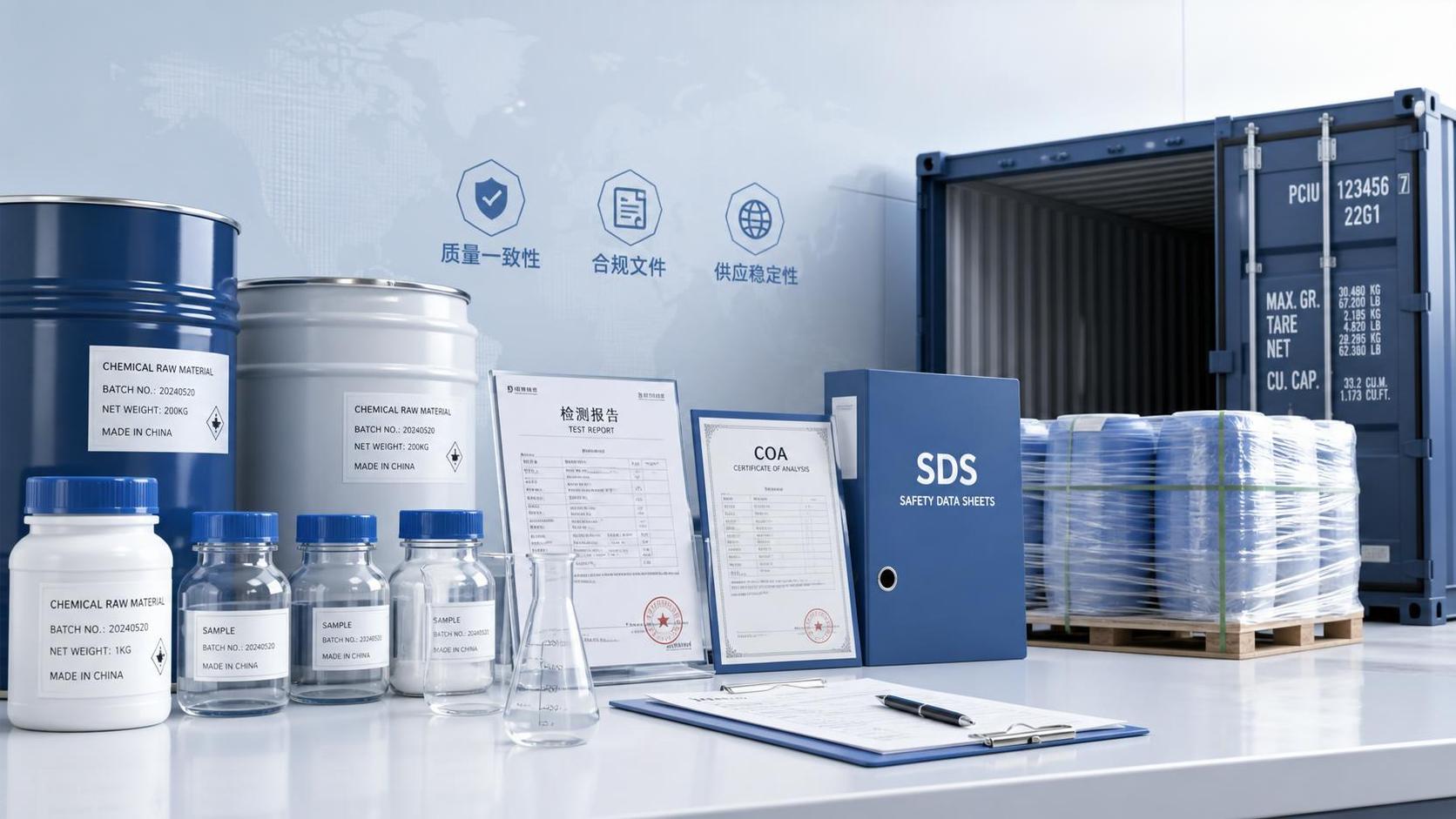
If you are considering a supplier change, the first thing to know is simple: cheaper Chemical Raw Materials are not automatically lower-cost materials. A new supplier can improve margins, but it can also create hidden losses through unstable quality, delayed deliveries, requalification work, customer complaints, or inventory disruption. The right evaluation is not just about unit price. It is about whether the supplier can deliver the same material, with the same reliability, under the same commercial and regulatory expectations your operation depends on.
Many teams get stuck because the quote looks attractive, the samples pass a basic test, and the sales response is fast. That still tells you very little about long-term performance. In chemical purchasing, the real question is whether the supplier is dependable when volumes rise, specifications tighten, shipping conditions change, or an audit request lands unexpectedly.
A useful way to think about this decision is: do not compare suppliers only as vendors; compare them as risk profiles.
Start with the material itself, not the brochure
When companies switch suppliers of Chemical Raw Materials, the most common mistake is treating the product name as proof of equivalence. In practice, two materials can share the same common name and still behave differently in production.
That difference may come from purity range, impurity pattern, moisture content, particle size distribution, inhibitor package, bulk density, odor, color stability, or packaging conditions. On paper, these may look minor. On a production line, they may affect reaction rate, blending behavior, storage stability, yield, filtration, or final product appearance.
So the first check is not “Does this supplier sell the same item?” It is “Does this material perform the same way in our process?”
Ask for the current specification sheet, typical values, certificate of analysis format, safety data sheet, and, if relevant, technical data that shows batch-to-batch variability. Then compare those documents against your actual internal acceptance criteria, not just the broad description used in procurement records.
In many organizations, the purchasing file says one thing and the plant actually needs something narrower. That gap becomes visible only when a new source is introduced.
A short answer, if you need one: before changing suppliers, verify product equivalence, compliance status, supply continuity, logistics capability, and full landed cost. If any one of those is unclear, the switch is not fully evaluated yet.
Consistency matters more than a good first sample
A lab sample can be clean, on-spec, and still fail to represent commercial reality. This is one of the oldest traps in raw material sourcing.
What you need to understand is whether the supplier can hold quality over time. That means asking questions that go beyond sample approval:
- How many production sites make this grade?
- Is the sample from a pilot batch, trial batch, or regular commercial production?
- How often does the supplier run this product?
- What are the most common causes of batch variation?
- What change control process exists for raw materials, process conditions, and packaging?
If your application is sensitive, request multiple batch samples, not one. For some Chemical Raw Materials, especially those used in coatings, adhesives, plastics, personal care, water treatment, or formulated industrial products, the problem is rarely total failure. It is drifting performance. A slight shift in impurity profile or viscosity may not trigger a rejection immediately, but it can create instability downstream.
This is where experienced evaluators separate a sourcing opportunity from a sourcing gamble. They look for evidence of control, not just evidence of availability.
Documents are not paperwork only
In chemical procurement, documentation quality often predicts operating quality.
If a supplier is slow, vague, or inconsistent when providing core documents, that usually shows up later in other parts of the relationship. Review the basics carefully: SDS, TDS, specification, COA template, regulatory declarations, transport classification, origin information if relevant, and any statements tied to restricted substances or industry-specific compliance needs.
The exact list depends on your market and application, so this must be checked against current official requirements and your internal compliance framework. There is no safe shortcut here.
Also look at version control. Are the documents dated? Do they identify manufacturing site? Are revision histories clear? Can the supplier explain differences between typical values and release limits? These sound like small administrative details, but they tell you whether the supplier runs a disciplined technical system or merely reacts when customers ask questions.
If your business sells into regulated or audit-heavy sectors, this check becomes even more important. A supplier that is acceptable for a general industrial use case may be unsuitable for tighter customer environments.
Supply stability is where many “good deals” fail
Price savings disappear quickly when deliveries become unpredictable. Before switching, assess how secure the supply base really is.
There are several things worth checking:
- Manufacturing location and whether there is a backup site
- Feedstock dependency and exposure to upstream volatility
- Normal lead times versus peak-season lead times
- Minimum order quantities and flexibility on replenishment
- Inventory policy for export customers or contract accounts
- History of force majeure, allocation, or shipping disruption
You may not get full transparency on everything, but the conversation itself is revealing. Strong suppliers can usually explain where their supply risks sit and how they manage them. Weak ones tend to answer only with reassurance.
One practical point is often overlooked: a supplier may be reliable at your current volume but unreliable at your future volume. If your demand is expected to grow, ask whether the supplier has capacity reserved, whether they are already heavily committed, and what happens if your monthly call-off doubles. This matters more than many teams expect.
Logistics and packaging deserve a harder look
Chemical Raw Materials do not become usable just because they were produced correctly. They also need to arrive in acceptable condition, in acceptable time, with packaging suited to your storage and handling system.
That means checking packaging type, net weight tolerance, labeling consistency, pallet configuration, container loading practice, seal control, shelf-life marking, and temperature sensitivity where relevant. A supplier with a technically acceptable product can still be a poor fit if the packaging creates contamination risk, extra labor, disposal cost, or warehouse inefficiency.
For imported materials, do not stop at freight cost. Look at customs documentation quality, hazardous goods handling competence if applicable, port-to-plant timing, and how claims are handled when shipment damage or delay occurs. Some sourcing changes look attractive only because the comparison ignored the operational burden on receiving, planning, QA, and finance.
Do not compare price without comparing the real cost to serve
This is usually the turning point in a supplier decision.
A lower quoted price can be offset by smaller but repeated costs: extra inspection, higher safety stock, production adjustment time, rejected batches, more frequent expediting, payment risk, packaging waste, or working capital pressure from different order terms.
So when you compare offers, build a wider cost view. Include at least:
- Quoted unit price
- Freight and inland delivery
- Duties or local tax effects where applicable
- Payment terms
- MOQ impact on inventory
- Testing and qualification cost
- Expected risk cost if performance variability is higher
Not every item can be quantified precisely, and that is fine. The point is to avoid false precision. A rough but honest total-cost model is better than a clean-looking spreadsheet built on incomplete assumptions.
Audit the supplier’s way of working, even if the audit is informal
You do not always need a full on-site audit before trialing a supplier, but you do need some view into how they operate.
Look at response quality. When you ask technical questions, do you get direct answers or recycled sales language? When deviations happen, is there a corrective action process? Are commercial, quality, and logistics contacts aligned, or does each team say something different?
These signals matter because switching suppliers is rarely a one-time transaction. It is the start of a problem-solving relationship. In chemical supply, issues eventually happen somewhere: a delayed vessel, a packaging defect, a spec query, an allocation event, a revised document. What separates a workable supplier from a costly one is not the promise of zero problems. It is how competently those problems are handled.
When a switch makes sense, and when it does not
A supplier change is usually justified when the current source has recurring service failures, weak commercial terms, unresolved quality issues, or limited ability to support growth. It also makes sense when dual sourcing is strategically necessary, especially for materials with supply concentration risk.
It may be a poor decision when your process is highly sensitive, your customer approval chain is slow, or the expected savings are too small to justify requalification effort and operational exposure. In those cases, the switch can consume more internal time than it returns in value.
That is why experienced teams do not ask only, “Can we switch?” They ask, “What problem are we solving by switching, and is the gain large enough to carry the risk?”
A practical decision filter
If you need a simple internal standard, use this: do not approve a supplier of Chemical Raw Materials until five points are clear.
- The material has been verified as fit for your real process, not just matching by name.
- The supplier can show stable quality control and usable documentation.
- Supply and capacity risk are understood well enough for your planning horizon.
- Logistics, packaging, and claims handling fit your operation.
- The total commercial picture still works after adding hidden costs and transition effort.
When those five are in place, a switch becomes a managed decision rather than a price-driven experiment.
In the end, the strongest supplier is not always the one with the lowest number on the quote sheet. It is the one that reduces uncertainty while still meeting your commercial target. That is the standard worth using when you evaluate Chemical Raw Materials for a supplier change.
FAQ
Is a passed sample test enough to approve a new supplier?
No. A sample only shows that one batch met your test conditions. You still need confidence in batch consistency, document control, and supply reliability.
How many suppliers should be compared before switching?
There is no fixed number. In most cases, two to three serious options are enough if the technical and commercial comparison is deep enough.
Should price be the main reason to switch?
Usually not by itself. Price matters, but only after you understand quality risk, logistics burden, and transition cost.
When is dual sourcing better than full replacement?
When the material is critical, customer-sensitive, or exposed to upstream disruption. Dual sourcing can lower risk without forcing a complete changeover.
What is the biggest hidden risk in switching chemical suppliers?
Gradual inconsistency. Materials may stay nominally on-spec while causing process instability, yield loss, or quality drift over time.
Internal link anchor text suggestions
- chemical raw material quality control: supplier qualification or QA standards page
- how to compare chemical suppliers: procurement guide or comparison article
- chemical raw material COA and SDS checklist: compliance resource page
- total cost of ownership in chemical purchasing: cost analysis article
- dual sourcing strategy for industrial chemicals: supply chain risk page
External authority source directions
- government chemical regulation and workplace safety agency pages
- industry association guidance on responsible chemical distribution and supply practices
- official technical and regulatory documentation from manufacturers or major producers
Navigation
- How pharmaceutical raw materials are checked for GMP compliance
- What to check before switching suppliers of chemical raw materials
- Where inorganic chemicals still hold an advantage over organic options
- What affects the cost volatility of key organic intermediates
- When do water treatment chemicals fail to control scaling effectively
Send Us A Message